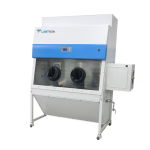
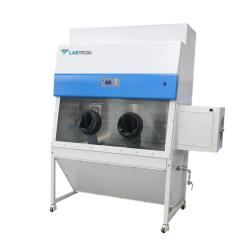
Class III Biosafety Cabinet is designed to work best with risk groups or isolation of type 04 hazards. The gas-tight enclose design ensures the safety of the environment and that of worker from the specimen that being studied. Work is performed with long-sleeved gloves. Device is kept under negative pressure of at least 120 Pa, dedicated exterior exhaust system maintained the airflow of cabinet and offers total barrier protection for operator, product and environment.
External dimension (W×D×H)
1540×880×2000 mm
Internal dimension (W×D×H)
910×650×660 mm
Pre-filter
Polyester fiber, washable
Negative work zone pressure
≥ -120 Pa
HEPA Filter Air supply
99.999% efficiency at 0.3μm
HEPA Filter First Exhaust
99.999% efficiency at 0.3μm
HEPA Filter Second Exhaust
99.999% efficiency at 0.3μm
Noise
NSF 49 ≤61 dB/EN 12469≤48 dB
number of gloves port
2
Gloves type
One pair of 800 mm butyl rubber gloves
Front Window
8 mm toughened glass, anti-ultraviolet radiation
Pass Box Internal dimension (W×D×H)
430×330×355 mm
Pass Box External dimension (W×D×H)
575×425×495 mm
Alarm
Audio and visual alarm, abnormal pressure; filter replacement
Work Zone Material
304 stainless steel
Illumination
≥ 1000 lux
Power consumption
1200 W
LED lamp
12 W × 2
UV lamp
18W×2, 8W×1, Emission of 253.7 nm for most efficient decontamination
Power Supply
AC220 V±10% ,50/60 Hz;110 V±10%,60 Hz
Gross weight
350 kg
Dimension
1635×1062×2160 mm
With memory function in case of power-failure
UV lamp ensures work area sterilization effectively
Exhaust air is double-filtered through high-quality HEPA filters
Integrated pass-through with interlocking doors
Polyester fiber is washable through Pre-filter
Designed by audio and visual alarm
Front window: 8mm toughened glass, anti-ultraviolet radiation
Equipped by fluorescent lamp and UV lamp for sterilization effectively
LCD display control panel
Biological Safety Cabinet Class III are among the most effective and most commonly used primary containment devices in laboratories working with infectious agents. Designed for an absolute level of containment, it is frequently used for work involving the deadliest biohazards, bacteria, viruses and microorganisms.
 info@laboscience.com